
“At least I got in my protein in today. I may not eat much ‘rabbit food’ (vegetables), but I eat steak and eggs for breakfast; and, I take protein shakes to get in at least 100 grams of protein a day! So, I know I’m healthy.” Right?
| Protein Source | Amount | Protein (g) |
|---|---|---|
| Steak (lean cut) | ¼ lb | 29 |
| Salmon | 3 oz | 22 |
| Eggs | 2 large | 21 |
| Milk (skim) | 1 cup | 6 |
| Soybeans | 1 cup | 19 |
| Lentil Beans | 1 cup | 18 |
| Pinto Beans | 1 cup | 22 |
| Quinoa | 1 cup | 8 |
| Broccoli | 1 cup | 8 |
| Spinach | 1 cup | 6 |
Why Protein?
America’s preoccupation with protein began with the discovery of protein as a nutrient in the 19th century. Protein has been propounded as the central dietary nutrient by the USDA – dominated by the cattle, dairy, and egg industries – since before the 1940’s. In recent decades the protein mantra has been significantly increased in the sports supplement market. Protein powders, shakes, and bars are prominently featured and sold in every commercial Gymnasium and Health Spa.
It is very profitable. It is a multi- Billion Dollar Industry! There is a large amount of propaganda suggesting that to be strong and fit you need to increase your protein intake. Therefore, we are chronically anxious that we are not eating enough of it.
How much protein do you need to be healthy?
Let’s begin by stating that except for treating people suffering from very rare malabsorption syndromes or those in severe catabolic stress (as in late-stage cancer) doctors do not treat, or see, protein deficiency in the United States. A lack of protein does not exist for either normal people or for the typical athlete. Our culture has been convinced by media, USDA, and commercial interests to be constantly worried about something that is generally impossible to achieve- insufficient protein intake.
Since the 1940s studies have demonstrated that the median protein requirement is roughly 0.66 grams per kilogram (Kg) lean body weight (LBW)* of protein per day. This is less than ½ gm per pound! If we increase this statistically to the 2nd standard deviation you derive the typically quoted 0.8 grams per Kg protein per day as a cushion to cover almost everyone’s needs. You will notice that this USDA recommendation sets an RDA (Recommended Daily Allowance) not an MDA (Minimum). Consider the source of this recommendation. This 0.8gm/Kg number is really more of a Maximum amount than a Minimum for the average American. High intensity athletes, and people older than 60 may require a little more. Talk to your doctor about this.
Protein Requirement per day by lean Body Weight based on the 0.8g/Kg protein benchmark and the median 0.66gm/kg lean body protein requirement:
| 0.8g/kg LBW Protein Calculation | 0.66g/kg LBW Calculation |
|---|---|
| 125 lbs (LBW) = 57 kg × 0.8 = 45 g | 57 kg × 0.66 = 37 g |
| 150 lbs (LBW) = 68 kg × 0.8 = 54 g | 68 kg × 0.66 = 45 g |
| 200 lbs (LBW) = 91 kg × 0.8 = 72 g | 91 kg × 0.66 = 60 g |
* LBW: These recommendations are based on “lean body weight (LBW)”. If you calculate your need for protein with your current total weight you can overestimate your protein needs by 15 to 40% depending on your amount of body fat.
* BMI: Your optimal BMI is often misstated as “ …as less than 25.”. A BMI between 22 and 23 [on an optimal diet] is best for most Americans. Those of Asian descent should strive for a maximum BMI of 20 to 22.
The 0.8gm/kg protein benchmark is a substantially inflated figure for many people. Proponents of Paleo or Carnivore- both High protein, High fat, Low Carbohydrate diets advocate 1.2 to 1.6g protein/Kg LBW of protein per day!??
“It doesn’t matter if I take in too much protein, it can’t hurt me.”
It is often assumed that you can’t get too much protein; but is it true?
Animal Protein and Cancer:
Dr T. Colin Campbell authored The China Study, the largest population study ever published on nutrition. He states that cultures eating a high animal protein diet suffer from the highest rate of cancer mortality. Cancer is the second leading cause of death in the US. This would include a higher incidence of prostate, breast, colon, liver, and kidney cancers, among other cancers.
Normal people initiate cancer frequently in the course of their lives. We develop clusters of abnormal cells; but they rarely develop their life-threatening potential. This is because the body’s immune surveillance system snuffs these incipient cancers out. We put out the embers before they flame! However, if our body sends messages to halt this immune process, the cancer may be promoted and spread.
Excess animal protein elicits the production of Insulin Like Growth Factor (IGF1) and other compounds (Heterocyclic Amines, Polycyclic Aromatic Hydrocarbons, and Trimethylamine N- Oxide [TMAO see ** below]). IGF1 and TMAO act like growth hormones for cancer. Dr. Campbell specifically cites Casein (the protein in Milk and Cheese) as “…the most significant carcinogen discovered in the past century.”
Excessive animal meat and dairy protein and Heme Iron (Iron from animal blood) consumption stimulate the production of inflammatory compounds. They are associated with cancer of the Colon, Breast, Prostate, and Liver.
However, plant protein does not appear to be a cancer promoter. This is big news! Not only do you need less protein than you have been led to believe, but too much animal derived protein may be lethal!
Protein Intake and Kidney Disease [aka Renal Disease] (1):
North Americans often eat 2 to 3 times more protein than they need. Animal meat intake has the additional risk of intensifying renal (kidney) compromise, especially for diabetic patients; and high animal protein intake increases the risk of kidney failure, dialysis, and early death*(see below). Renal patients are routinely recommended a low protein diet.
Protein Intake and Bone Health:
Too much animal protein creates an acidic environment which, some researchers believe, decreases bone calcium as a buffering mechanism in this highly acid environment. This may lead to bone loss and osteoporosis. In the USA, Finland and the United Kingdom, the highest per capita consumers of milk products, have the highest rate of osteoporosis and bone fracture in the world! Too much animal protein often has serious consequences.
Animal Protein, Saturated Fat, and Heart Disease:
High content of saturated fats and cholesterol is found in animal derived food sources (red meat, chicken, milk, cheese); is implicated in the epidemic of heart disease and diabetes in western society (Heart Disease is the greatest killer of people you know). Excess saturated fat accompanies the consumption high protein animal-based foods.
As we discuss elsewhere, Choline and Carnitine from Red Meat, Chicken, and Eggs induce gut bacteria to produce TMAO. Increased TMAO levels are linked to atherosclerosis (heart plaque), chronic kidney disease, and heart failure (2)
Heme Iron, Fat and Diabetes:
It is now well known that the concentrated saturated fat, in the meat/dairy western diet, is the primary cause of insulin resistance leading to the development of Type 2 Diabetes.
There is a burgeoning literature that suggests that a high consumption of heme- based animal protein is associated with damage to the Insulin producing Islet cell of the pancreas. It is beginning to appear that animal meat derived Heme- Iron accelerates the development of Type 2 Diabetes especially in people eating excess Saturated Fat from animals. Diabetes is now an epidemic condition in North America. Diabetes is rare in peoples who eat primarily plants and tubers (like sweet potatoes). 47% of adult American adults are now “pre- diabetic” up from 8 % just 50 years ago!
Adequate Protein
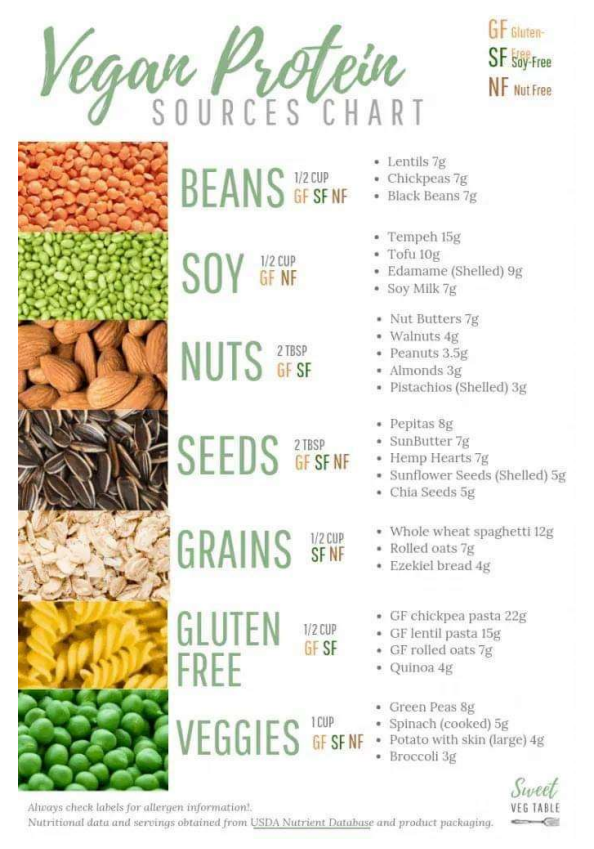
Selected high protein sources from plant foods:
- Legumes [beans, soy, chickpeas, lentils]: 15-20 gm cooked 1 cup
- Tofu: 10-15 gm in 3.5 oz
- TVP see^ below: 50 gr dry 3.5 oz
- Seitan see^^ below: 22-25 gm in 3.5 oz
- Nuts and Seeds: 15-20 gm in 3.5 oz
- Grains: 5 to 12 gm ½ cup
- Bread: 5 gm in 2 slices
- ½ cup Farro wheat 12 gm
- ½ cup brown rice 4 gm
- Broccoli 2.6 gm
- Kale 2.21gm
^ TVP => Textured Veg Protein
^^Seitan => Wheat extracted protein
Theoretical Daily Consumption:
| Food Item | Protein (g) |
|---|---|
| 1 cup Legumes (Beans, Chickpeas, Lentils) | 18 g |
| ¾ cup Farro (wheat grain) | 18 g |
| 1 cup cooked oatmeal | 5 g |
| 2 cups broccoli | 5.2 g |
| 4 cups Kale | 8.84 g |
| Nuts and Seeds (3.5 oz) | 18 g |
| 1 cup Almond Milk | 1 g |
| Total | 73.6 g |
Additional Information- “Extra Credit”😊
“I’ve been told you can’t be an athlete, or fit, on a Vegan Diet.”:
I suggest that you peruse the documentary listed here:
A wonderful documentary “The Game Changers” – dispels some of the mythology around protein intake, strength, and athletic prowess.
Essential Amino Acids:
Amino Acids are the building blocks of protein. Proteins are prime components of striated and smooth muscles (from biceps to heart), the structure of cell walls, the thousands of catalytic enzymes your body uses daily, and your DNA.
Some Amino Acids are considered Essential. These are Amino Acids that your body can’t manufacture and must be consumed in your dietary intake.
Of the 20 Amino Acids, 9 are ‘Essential’. These are:
Valine, Phenylalanine, Threonine, Tryptophan, Methionine, Leucine, Isoleucine, Lysine, and Histidine.
Wikipedia states that “… Although plants tend to have less protein per weight than animal sources such as eggs or milk, they are nevertheless “complete” in that, as a whole, they contain all of the amino acids essential in human nutrition.[9] -https://en.wikipedia.org/wiki/Essential amino acid- -“
Vegetables and beans often contain more protein per calorie than found in eggs or beef.
Dr. John’s Nutrition Health
The Plant- Based nutritional program at DrJohnsNutritionHealth.com provides you with a more than adequate amount of Protein in your diet. The high concentration of Vitamins, Minerals, Antioxidants, and Phytochemistry in this food is life enhancing, healing, and energy promoting. Let’s get busy being healthy!
Recommended reading:
Book: Garth Davis, MD- PROTEINAHOLIC. An eminent obesity surgeon’s observation on the misinformation disseminated concerning the ‘Standard American Diet’ and its catastrophic consequences. This book is one of the best bibliographic resource references available.
- Kidney disease is among the top 10 killers in the USA. See: https://www.cdc.gov/nchs/fastats/deaths.htm .Click on this link for the CDC list of the most common causes of death in the United states. 70% are preventable!
- Wang Z, Bergeron N, Levison BS, et al. Impact of chronic dietary red meat, white meat, or non-meat protein on trimethylamine N-oxide (TMAO) metabolism and renal excretion in healthy men and women. Eur Heart J. Published online December 10, 2018.
**Increased TMAO levels are linked to atherosclerosis, chronic kidney disease, and heart failure; and, according to these authors, may be one of the reasons for the “relatively consistent association” between red meat consumption and heart attack, stroke, mortality, and cardiovascular disease development.